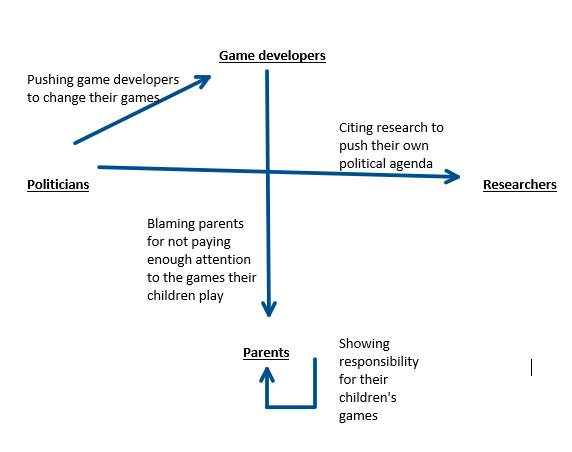
Each of these groups are more apt to blame someone rather than talk about how they themselves can help resolve violence in society and the role of video games in modern society.
Each of these groups are more apt to blame someone rather than talk about how they themselves can help resolve violence in society and the role of video games in modern society.
In my revision of my discourse analysis, I fine-tuned several things in the essay. I specifically focused on my excessive use of conjunctive adverbs as well as my introduction and conclusion. After your words of advice on rereading my paper, I started to notice how I was using the words ‘however’, ‘therefore’, and ‘also’. Writing each sentence separately these sound like good words to transition with. The problem arises when it is overused to the point where almost every other sentence is like this. Cleaning up the instances of this makes the paper read more smoothly. The other aspects I focused on, the introduction and conclusion, were the most important to correct. This is mainly because before this course, no teacher ever really cared to point out its importance. As for the media project, I believe that the effort put into the DIE speaks for itself. However, I believe that the most important thing to think about when going into our game is to remember that most aspects of the game are the way they are to enhance the game’s experience. This is in the sense of how it would help with the underlying message.
Video Games are Turning Kids into Murderers?
There has been a discussion into the relationship between violence and video games since the first games to depict it were released to the public. It seems like every time a tragesty strikes in the United States by the youth, it is met with several different groups arguing about its root cause. Ideal conversations are effective in finding a resolution to pressing problems that face the general public. However, in this discourse, there is no push to find the solution to the violence in our youth or the role of video games in our society. This is the big divergence from an ideal conversation and is the reason no-one has been able to come to a consensus. Whether knowingly or not, each group is dodging blame. They instead shifting it to each other and avoid finding the solution itself.
Literature Review
There is lots of conflicting but mostly insightful research into the relationship between video games and violence. Currently, the APA believes there is a link between the two, but video games do not cause violent tendencies. Their stance is that the games can aid in the development of some people’s aggression but can also be used to encourage healthy choices. Dr. Patrick Marke believes that there are three particular personality traits that can predict who is more likely to be violent after playing violent video games. These are high neuroticism, low agreeability, and low conscientiousness. When thinking about these three traits, they were able to accurately predict which children were more prone to violence. According to A. K. Przybylski , E. L. Deci , C. S. Rigby , and R. M. Ryan, the link between games and violence is caused by the human need for competence. This means that it is the frustration of not winning or failing that is the link to violent tendencies. This research is very good for a clearer understanding of what causes violence in relation to people that play video games. However, this information is not useful if it cannot be accepted by the other groups that are discussing this issue. Most talk about the subject revolves around why a different community is responsible for the violence, not how to solve it.
There are several big communities taking different sides on this issue. Politicians argue that video games cause violent acts of the youth. They have a large platform and are very vocal about their opinions. Instead of trying to change policies and laws, politicians such as President Trump and Lt. Gov. Dan Patrick believe that the video game industry is responsible for solving these problems. On the other hand, the video game industry is very quiet about their stance and only speak up when they are attacked directly. Strauss Zelnick, a video game executive director, pushes for gun control because he believes this to be the cause of the violence while the Entertainment Software Rating Board (ESRB) wants the parents to be more attentive to the games children play. The final group I will discuss, the parents, blame themselves in a way. Reviewers on CommonSenseMedia believe that it is their responsibility to monitor what games their children play. Even the bloggers on the Mom Blog Society website give information about what games to play with their own children.
While these different communities are debating who is at fault, I believe a more important question is why these groups deflect responsibility onto each other and what it means for the argument in a bigger scope. I am analyzing each group’s use of language and how the conversation flows between them. The discourse used by parents discussing violence and video games shifts blame onto themselves instead of onto other groups. Politicians are making the issue political but still avoid using their position to attempt a solution. The game developers remain silent on the issue until they are mentioned directly. This matters because this type of discussion does not help to resolve the problem of violence. Each group is shifting the blame around to avoid being at fault instead of working together to resolve the issue itself. This is an issue because this form of argument does not help anyone involved. When no solutions are proposed, the problem of violence in society only gets worse.
Discourse Analysis
In the discourse of violence in video games, every group participating does not do so to solve the problem. Their only goals are to throw the blame around to each other so that they themselves are not responsible. This is because they do not want to go through the tediousness of devising solutions and step from their comfort zones.
Politicians are more apt to point fingers at another group and not offer any solutions for the issue of violence and video games. President Trump avoids responsibility by focusing on the video game industry stating that ”We must stop the glorification of violence in our society. This includes the gruesome and grisly video games that are now commonplace”(Limbong). During a press release after the El Paso shooting, the president spoke on what he believed to be the problems at large. He accuses the gaming industry of glorifying violence without addressing what he can do to solve the issue. Dan Patrick, the lieutenant governor of Texas, actively removes responsibility from himself and aims it towards video games. ”’We’ve always had guns, always had evil, but I see a video game industry that teaches young people to kill’”(Rocha). Similarly, he addresses his opinions on violence after the El Paso shooting. He begins by blaming the video game industry and also fails to mentions how he can make a difference. These are people in high positions of power with the ability to enact change on a national scale. This evasion of responsibility is detrimental to finding a solution. They are so fixated on putting others into the spotlight without understanding how much they themselves can do to reduce outbreaks of violence.
What makes parents different in this discourse is that they do not accuse another group. Parents aim their blame at other parents and their decision-making skills. ”A lot of parents don’t understand that you can turn off blood and gore./ Most parents just don’t like to admit they’re child has grown up and play games like this”(ChelyRating). This is a commenter under a review for a Call of Duty game. They point out the features of the game that attempt to reduce the amount of violence children are exposed to. “On issues such as violence, patriotism, call of duty and responsibility, children and even adults have learned what it means to know and understand these terms using the almost real world of the video game” (Becky). This example further illustrates who parents feel are responsible for what games their children play. Parents are not blaming, guns, games, or even another group for the violence. This group alone points the blame towards themselves. While the parents are infighting about what other parents should and should not do, the problem of violence only gets worse.
Game developers benefit from a lack of decisive action from other groups, which is why they remain relatively silent. Their press releases and statements only come after they have been accused. The executive director for a video game franchise, Strauss Zelnick, fires shots at American politics. ” The fact is, entertainment is consumed worldwide, but gun violence is uniquely American”(Voytko). Zelnick responds to the accusations of video games causing violence. He blames the politics of gun control instead. This removes the responsibility from his company and others in the game developing industry. Pointing his finger at gun control would have everyone looking at the politicians for answers instead. ”’More than 165 million Americans enjoy video games, and billions of people play video games worldwide. Yet other societies, where video games are played as avidly, do not contend with the tragic levels of violence that occur in the U.S’”(Voytko). The Entertainment Software Association (ESA) is at the forefront of the video game industry. They respond in this statement to President Trump’s attack on their industry. Like every other group mentioned, they move the liability but they shift it to American society as a whole. This further complicates the discussion because it is a blanket statement meant to draw attention away from themselves and towards anyone else. The ESRB makes no attempts to change their direction even when attacked by another group. “‘Along with information to read on the box and online before you make a purchase decision, each game console offers robust parental controls that allow you to set time and spending limits, block content by age rating, restrict communication, and more,’ ESRB President Patricia Vance told USA TODAY. ‘There’s a ton of information available, so there should be no surprises.(Saltzman)” Vance points out that accusers are not looking into what they have done in the past to solve the issue of violence. She points at a different group to be responsible, the parents. The gaming industry is smart by betting the other groups go head to head in the discourse. Playing a reclusive role helps them but does not solve the more important goal of stopping the ongoing violence.
As you can see from the analysis of these groups, the discussion is circular in nature and does not converge onto a final solution. This is the underlying problem within the discourse of violence and video games because when looking at the arguments from the ground level, it seems as though the different groups care about the solution itself. However, when taking in the discussion as a whole, it is clear that they are only avoiding responsibility themselves. With all of this in mind, it should be easier for people to call out these groups when they are deflecting. Only when the deflection stops, can these groups come together to stop the rampant violence taking place in our society.
Bibliography
Becky. “How Video Games Influence Society.” Mom Blog Society, Mom Blog Society, 27 Feb. 2019, https://momblogsociety.com/video-games-influence-society/.
Ferguson, Christopher, and Patrick Markey. “Violent Video Games May Increase Aggression in Some But Not Others, Says New Research.” American Psychological Association, American Psychological Association, 7 June 2010, https://www.apa.org/news/press/releases/2010/06/violent-video-games.
Limbong, Andrew. “Video Games Are Still Blamed For Gun Violence Despite Studies Showing No Connection.” NPR, NPR, 5 Aug. 2019, https://www.npr.org/2019/08/05/748387407/video-games-are-still-blamed-for-gun-violence-despite-studies-showing-no-connect.
Przybylski, A. K., et al. “‘Competence-Impeding Electronic Games and Players Aggressive Feelings, Thoughts, and Behaviors’: Correction to Przybylski, Deci, Rigby, and Ryan (2013).” Journal of Personality and Social Psychology, vol. 106, no. 3, 2014, pp. 441–457., doi:10.1037/a0036148.
Rocha, Alana. “After El Paso Shooting, Texas Lt. Gov. Dan Patrick Says Video Games Teach Young People ‘to Kill.’” The Texas Tribune, The Texas Tribune, 4 Aug. 2019, https://www.texastribune.org/2019/08/04/dan-patrick-video-games-el-paso-shooting/.
Saltzman, Marc. “Video Game Industry Pushes Back on Trump’s Violence Link, Stresses Parental Tools.” USA Today, Gannett Satellite Information Network, 13 Aug. 2019, https://www.usatoday.com/story/tech/columnist/2019/08/06/shootings-resurface-video-game-violence-claims-but-industry-counters/1930495001/.
Sapieha, Chad. “Parent Reviews for Call of Duty: Black Ops 4: Common Sense Media.” Common Sense Media: Ratings, Reviews, and Advice, Common Sense Media, 14 Oct. 2018, https://www.commonsensemedia.org/game-reviews/call-of-duty-black-ops-4/user-reviews/adult.
Voytko, Lisette. “Video Game Industry Rejects Criticism By Trump And GOP After Mass Shootings.” Forbes, Forbes Magazine, 6 Aug. 2019, https://www.forbes.com/sites/lisettevoytko/2019/08/06/video-game-industry-rejects-trump-gop-criticism-after-mass-shootings/#20863e54b9f5.
Laboratory Strategy Draft
In the discourse of violence in video games, every group participating does not do so to solve the problem. Their only goals are to throw the blame around to each other so that they themselves are not responsible. This is because they do not want to go through the tediousness of devising solutions and step from their comfort zones.
Politicians
Politicians are more apt to point fingers at another group and not offer any solutions for the issue of violence and video games.
Trump
President Trump avoids responsibility by focusing on the video game industry.
” We must stop the glorification of violence in our society. This includes the gruesome and grisly video games that are now commonplace”(Limbong).
During a press release after the El Paso shooting, the president spoke on what he believed to be the problems at large. He accuses the gaming industry of glorifying violence without addressing what he can do to solve the issue.
Lt. Gov. Dan Patrick
Dan Patrick actively removes responsibility from himself and aims it towards video games.
”’We’ve always had guns, always had evil, but I see a video game industry that teaches young people to kill’”(Rocha).
Similarly, he addresses his opinions on violence after the El Paso shooting. He begins by blaming the video game industry and also fails to mentions how he can make a difference.
These are people in high positions of power with the ability to enact change on a national scale. This evasion of responsibility is detrimental to finding a solution. They are so fixated on putting others into the spotlight without understanding how much they themselves can do to reduce the outbreaks of violence.
Parents
What makes parents different in this discourse is that they do not accuse another group.
CommonSenseMedia
Parents aim their blame at other parents and their decision-making skills.
”A lot of parents don’t understand that you can turn off blood and gore./ Most parents just don’t like to admit they’re child has grown up and play games like this”(ChelyRating).
This is a commenter under a review for a Call of Duty game. They point out the features of the game that attempt to reduce the amount of violence children are exposed to.
MomBlogSociety
“On issues such as violence, patriotism, call of duty and responsibility, children and even adults have learned what it means to know and understand these terms using the almost real world of the video game” (Becky).
This example further illustrates who parents feel are responsible for what games their children play. Parents are not blaming, guns, games, or even another group for the violence. This group alone points the blame towards themselves.
While the parents are infighting about what other parents should and should not do, the problem of violence only gets worse.
Game Developers
Game developers benefit from a lack of decisive action from other groups, which is why they remain relatively silent. Their press releases and statements only come after they have been accused.
RDR
The executive director for a video game franchise, fires shots at American politics.
”’ The fact is, entertainment is consumed worldwide, but gun violence is uniquely American’”(Voytko).
Zelnick responds to the accusations of video games causing violence. He blames the politics of gun control instead. This removes the responsibility from his company and others in the game developing industry. Pointing his finger at gun control would have everyone looking at the politicians for answers instead.
ESA
More than 165 million Americans enjoy video games, and billions of people play video games worldwide. Yet other societies, where video games are played as avidly, do not contend with the tragic levels of violence that occur in the U.S’”(Voytko).
The Entertainment Software Association (ESA) is at the forefront of the video game industry. They respond in this statement to President Trump’s attack on their industry. Like every other group mentioned, they move the liability but they shift it to American society as a whole. This further complicates the discussion because it is a blanket statement meant to draw attention away from themselves and towards anyone else.
ESRB
The Entertainment Software Rating Board(ESRB) makes no attempts to change their direction even when attacked by another group.
“‘Along with information to read on the box and online before you make a purchase decision, each game console offers robust parental controls that allow you to set time and spending limits, block content by age rating, restrict communication, and more,’ ESRB President Patricia Vance told USA TODAY. ‘There’s a ton of information available, so there should be no surprises.(Saltzman)”
Vance points out that accusers are not looking into what they have done in the past to solve the issue of violence. She points at a different group to be responsible, the parents.
The gaming industry is smart by betting the other groups go head to head in the discourse. Playing a reclusive role helps them but does not solve the more important goal of stopping the ongoing violence.
As you can see from the analysis of these groups, the discussion is circular in nature and does not converge onto a final solution. This is the underlying problem with violence and video games because when looking at the arguments from the ground level, it seems as though the different groups care about the solution. However, when taking in the discussion as a whole, it is clear that they are only avoiding responsibility themselves.
Reverse Outline
Literature Review
There has been a discussion into the relationship between violence and video games since the first games to depict it were released to the public. Currently, the APA believes there is a link between the two but video games do not cause violent tendencies. Their stance is that the games can aid in the development of some people’s aggression but can also be used to encourage healthy choices. According to Dr. Patrick Markey, there are three particular personality traits that can predict who is more likely to be violent after playing violent video games. These are high neuroticism, low agreeability, and low conscientiousness. When thinking about these three traits, they were able to accurately predict which children were more prone to violence. Also, according to A. K. Przybylski , E. L. Deci , C. S. Rigby , and R. M. Ryan, the link between games and violence is caused by the human need for competence. This means that it is the frustration of not winning or failing that is the link to violent tendencies. This research is very good for a clearer understanding of what causes violence in relation to people that play video games. However, this information is not useful if it cannot be accepted by the other groups that are discussing this issue. Most talk about the subject revolves around why a different community is responsible for the violence, not how to solve it.
There are several big communities taking different sides on this issue. Politicians argue that video games cause violent acts of the youth. They have a large platform and are very vocal about their opinions. Instead of trying to change policies and laws, politicians such as President Trump and Lt. Gov. Dan Patrick believe that the video game industry is responsible for solving these problems. On the other hand, the video game industry is very quiet about their stance and only speak up when they are attacked directly. Strauss Zelnick pushes for gun control because he believes this to be the cause of the violence while the ESRB wants the parents to be more attentive to the games children play. The final group I will discuss, the parents, blame themselves in a way. Reviewers on CommonSenseMedia believe that it is their responsibility to monitor what games their children play. Even the bloggers on the Mom Blog Society website give information about what games to play with their own children.
While these different communities are debating who is at fault, I believe a more important question is why these groups deflect responsibility onto each other and what it means for the argument in a bigger scope. I am analyzing each group’s use of language and how the conversation flows between them. Again, the discourse used by parents discussing violence and videogames shifts blame onto themselves instead of onto other groups. Meanwhile, politicians are making the issue political. Also, the game developers remain silent on the issue until they are mentioned directly. This matters because this type of discussion does not help to resolve the problem of violence. Each group is shifting the blame around to avoid being at fault instead of working to resolve the issue itself. This is an issue because this form of argument does not help anyone involved. When no solutions are proposed, the problem of violence in society only gets worse.
Discourse Analysis
In the discourse of violence in video games, every group participating does not do so to solve the problem. Their only goals are to throw the blame around to each other so that they themselves are not responsible. This is because they do not want to go through the tediousness of devising solutions and step from their comfort zones.
Politicians are more apt to point fingers at another group and not offer any solutions for the issue of violence and video games. President Trump avoids responsibility by focusing on the video game industry. ”We must stop the glorification of violence in our society. This includes the gruesome and grisly video games that are now commonplace”(Limbong). During a press release after the El Paso shooting, the president spoke on what he believed to be the problems at large. He accuses the gaming industry of glorifying violence without addressing what he can do to solve the issue. Dan Patrick actively removes responsibility from himself and aims it towards video games. ”’We’ve always had guns, always had evil, but I see a video game industry that teaches young people to kill’”(Rocha). Commentary: Similarly, he addresses his opinions on violence after the El Paso shooting. He begins by blaming the video game industry and also fails to mentions how he can make a difference. These are people in high positions of power with the ability to enact change on a national scale. This evasion of responsibility is detrimental to finding a solution. They are so fixated on putting others into the spotlight without understanding how much they themselves can do to reduce the outbreaks of violence.
What makes parents different in this discourse is that they do not accuse another group. Parents aim their blame at other parents and their decision-making skills. ”A lot of parents don’t understand that you can turn off blood and gore./ Most parents just don’t like to admit they’re child has grown up and play games like this”(ChelyRating). This is a commenter under a review for a Call of Duty game. They point out the features of the game that attempt to reduce the amount of violence children are exposed to. “On issues such as violence, patriotism, call of duty and responsibility, children and even adults have learned what it means to know and understand these terms using the almost real world of the video game” (Becky). This example further illustrates who parents feel are responsible for what games their children play. Parents are not blaming, guns, games, or even another group for the violence. This group alone points the blame towards themselves. While the parents are infighting about what other parents should and should not do, the problem of violence only gets worse.
Game developers benefit from a lack of decisive action from other groups, which is why they remain relatively silent. Their press releases and statements only come after they have been accused. The executive director for a video game franchise, fires shots at American politics. ”’ The fact is, entertainment is consumed worldwide, but gun violence is uniquely American’”(Voytko). Zelnick responds to the accusations of video games causing violence. He blames the politics of gun control instead. This removes the responsibility from his company and others in the game developing industry. Pointing his finger at gun control would have everyone looking at the politicians for answers instead. ”’More than 165 million Americans enjoy video games, and billions of people play video games worldwide. Yet other societies, where video games are played as avidly, do not contend with the tragic levels of violence that occur in the U.S’”(Voytko). The Entertainment Software Association (ESA) is at the forefront of the video game industry. They respond in this statement to President Trump’s attack on their industry. Like every other group mentioned, they move the liability but they shift it to American society as a whole. This further complicates the discussion because it is a blanket statement meant to draw attention away from themselves and towards anyone else. The Entertainment Software Rating Board(ESRB) makes no attempts to change their direction even when attacked by another group. “‘Along with information to read on the box and online before you make a purchase decision, each game console offers robust parental controls that allow you to set time and spending limits, block content by age rating, restrict communication, and more,’ ESRB President Patricia Vance told USA TODAY. ‘There’s a ton of information available, so there should be no surprises.(Saltzman)” Vance points out that accusers are not looking into what they have done in the past to solve the issue of violence. She points at a different group to be responsible, the parents. The gaming industry is smart by betting the other groups go head to head in the discourse. Playing a reclusive role helps them but does not solve the more important goal of stopping the ongoing violence.
As you can see from the analysis of these groups, the discussion is circular in nature and does not converge onto a final solution. This is the underlying problem with violence and video games because when looking at the arguments from the ground level, it seems as though the different groups care about the solution. However, when taking in the discussion as a whole, it is clear that they are only avoiding responsibility themselves.
Bibliography
Becky. “How Video Games Influence Society.” Mom Blog Society, Mom Blog Society, 27 Feb. 2019, https://momblogsociety.com/video-games-influence-society/.
Ferguson, Christopher, and Patrick Markey. “Violent Video Games May Increase Aggression in Some But Not Others, Says New Research.” American Psychological Association, American Psychological Association, 7 June 2010, https://www.apa.org/news/press/releases/2010/06/violent-video-games.
Limbong, Andrew. “Video Games Are Still Blamed For Gun Violence Despite Studies Showing No Connection.” NPR, NPR, 5 Aug. 2019, https://www.npr.org/2019/08/05/748387407/video-games-are-still-blamed-for-gun-violence-despite-studies-showing-no-connect.
Przybylski, A. K., et al. “‘Competence-Impeding Electronic Games and Players Aggressive Feelings, Thoughts, and Behaviors’: Correction to Przybylski, Deci, Rigby, and Ryan (2013).” Journal of Personality and Social Psychology, vol. 106, no. 3, 2014, pp. 441–457., doi:10.1037/a0036148.
Rocha, Alana. “After El Paso Shooting, Texas Lt. Gov. Dan Patrick Says Video Games Teach Young People ‘to Kill.’” The Texas Tribune, The Texas Tribune, 4 Aug. 2019, https://www.texastribune.org/2019/08/04/dan-patrick-video-games-el-paso-shooting/.
Saltzman, Marc. “Video Game Industry Pushes Back on Trump’s Violence Link, Stresses Parental Tools.” USA Today, Gannett Satellite Information Network, 13 Aug. 2019, https://www.usatoday.com/story/tech/columnist/2019/08/06/shootings-resurface-video-game-violence-claims-but-industry-counters/1930495001/.
Sapieha, Chad. “Parent Reviews for Call of Duty: Black Ops 4: Common Sense Media.” Common Sense Media: Ratings, Reviews, and Advice, Common Sense Media, 14 Oct. 2018, https://www.commonsensemedia.org/game-reviews/call-of-duty-black-ops-4/user-reviews/adult.
Voytko, Lisette. “Video Game Industry Rejects Criticism By Trump And GOP After Mass Shootings.” Forbes, Forbes Magazine, 6 Aug. 2019, https://www.forbes.com/sites/lisettevoytko/2019/08/06/video-game-industry-rejects-trump-gop-criticism-after-mass-shootings/#20863e54b9f5.
Laboratory Strategy Draft
In the discourse of violence in video games, every group participating does not do so to solve the problem. Their only goals are to throw the blame around to each other so that they themselves are not responsible. This is because they do not want to go through the tediousness of devising solutions and step from their comfort zones.
Politicians
Politicians are more apt to point fingers at another group and not offer any solutions for the issue of violence and video games.
Trump
President Trump avoids responsibility by focusing on the video game industry.
” We must stop the glorification of violence in our society. This includes the gruesome and grisly video games that are now commonplace”(Limbong).
During a press release after the El Paso shooting, the president spoke on what he believed to be the problems at large. He accuses the gaming industry of glorifying violence without addressing what he can do to solve the issue.
Lt. Gov. Dan Patrick
Dan Patrick actively removes responsibility from himself and aims it towards video games.
”’We’ve always had guns, always had evil, but I see a video game industry that teaches young people to kill’”(Rocha).
Similarly, he addresses his opinions on violence after the El Paso shooting. He begins by blaming the video game industry and also fails to mentions how he can make a difference.
These are people in high positions of power with the ability to enact change on a national scale. This evasion of responsibility is detrimental to finding a solution. They are so fixated on putting others into the spotlight without understanding how much they themselves can do to reduce the outbreaks of violence.
Parents
What makes parents different in this discourse is that they do not accuse another group.
CommonSenseMedia
Parents aim their blame at other parents and their decision-making skills.
”A lot of parents don’t understand that you can turn off blood and gore./ Most parents just don’t like to admit they’re child has grown up and play games like this”(ChelyRating).
This is a commenter under a review for a Call of Duty game. They point out the features of the game that attempt to reduce the amount of violence children are exposed to.
MomBlogSociety
“On issues such as violence, patriotism, call of duty and responsibility, children and even adults have learned what it means to know and understand these terms using the almost real world of the video game” (Becky).
This example further illustrates who parents feel are responsible for what games their children play. Parents are not blaming, guns, games, or even another group for the violence. This group alone points the blame towards themselves.
While the parents are infighting about what other parents should and should not do, the problem of violence only gets worse.
Game Developers
Game developers benefit from a lack of decisive action from other groups, which is why they remain relatively silent. Their press releases and statements only come after they have been accused.
RDR
The executive director for a video game franchise, fires shots at American politics.
”’ The fact is, entertainment is consumed worldwide, but gun violence is uniquely American’”(Voytko).
Zelnick responds to the accusations of video games causing violence. He blames the politics of gun control instead. This removes the responsibility from his company and others in the game developing industry. Pointing his finger at gun control would have everyone looking at the politicians for answers instead.
ESA
More than 165 million Americans enjoy video games, and billions of people play video games worldwide. Yet other societies, where video games are played as avidly, do not contend with the tragic levels of violence that occur in the U.S’”(Voytko).
The Entertainment Software Association (ESA) is at the forefront of the video game industry. They respond in this statement to President Trump’s attack on their industry. Like every other group mentioned, they move the liability but they shift it to American society as a whole. This further complicates the discussion because it is a blanket statement meant to draw attention away from themselves and towards anyone else.
ESBR
The Entertainment Software Rating Board(ESRB) makes no attempts to change their direction even when attacked by another group.
“‘Along with information to read on the box and online before you make a purchase decision, each game console offers robust parental controls that allow you to set time and spending limits, block content by age rating, restrict communication, and more,’ ESRB President Patricia Vance told USA TODAY. ‘There’s a ton of information available, so there should be no surprises.(Saltzman)”
Vance points out that accusers are not looking into what they have done in the past to solve the issue of violence. She points at a different group to be responsible, the parents.
The gaming industry is smart by betting the other groups go head to head in the discourse. Playing a reclusive role helps them but does not solve the more important goal of stopping the ongoing violence.
As you can see from the analysis of these groups, the discussion is circular in nature and does not converge onto a final solution. This is the underlying problem with violence and video games because when looking at the arguments from the ground level, it seems as though the different groups care about the solution. However, when taking in the discussion as a whole, it is clear that they are only avoiding responsibility themselves.
Reverse Outline
In the discourse of violence in video games, every group participating does not do so to solve the problem. Their only goals are to throw the blame around to each other so that they themselves are not responsible. This is because they do not want to go through the tediousness of devising solutions and step from their comfort zones.
Politicians are more apt to point fingers at another group and not offer any solutions for the issue of violence and video games. President Trump avoids responsibility by focusing on the video game industry. ”We must stop the glorification of violence in our society. This includes the gruesome and grisly video games that are now commonplace”(Limbong). During a press release after the El Paso shooting, the president spoke on what he believed to be the problems at large. He accuses the gaming industry of glorifying violence without addressing what he can do to solve the issue. Dan Patrick actively removes responsibility from himself and aims it towards video games. ”’We’ve always had guns, always had evil, but I see a video game industry that teaches young people to kill’”(Rocha). Commentary: Similarly, he addresses his opinions on violence after the El Paso shooting. He begins by blaming the video game industry and also fails to mentions how he can make a difference. These are people in high positions of power with the ability to enact change on a national scale. This evasion of responsibility is detrimental to finding a solution. They are so fixated on putting others into the spotlight without understanding how much they themselves can do to reduce the outbreaks of violence.
What makes parents different in this discourse is that they do not accuse another group. Parents aim their blame at other parents and their decision-making skills. ”A lot of parents don’t understand that you can turn off blood and gore./ Most parents just don’t like to admit they’re child has grown up and play games like this”(ChelyRating). This is a commenter under a review for a Call of Duty game. They point out the features of the game that attempt to reduce the amount of violence children are exposed to. “On issues such as violence, patriotism, call of duty and responsibility, children and even adults have learned what it means to know and understand these terms using the almost real world of the video game” (Becky). This example further illustrates who parents feel are responsible for what games their children play. Parents are not blaming, guns, games, or even another group for the violence. This group alone points the blame towards themselves. While the parents are infighting about what other parents should and should not do, the problem of violence only gets worse.
Game developers benefit from a lack of decisive action from other groups, which is why they remain relatively silent. Their press releases and statements only come after they have been accused. The executive director for a video game franchise, fires shots at American politics. ”’ The fact is, entertainment is consumed worldwide, but gun violence is uniquely American’”(Voytko). Zelnick responds to the accusations of video games causing violence. He blames the politics of gun control instead. This removes the responsibility from his company and others in the game developing industry. Pointing his finger at gun control would have everyone looking at the politicians for answers instead. ”’More than 165 million Americans enjoy video games, and billions of people play video games worldwide. Yet other societies, where video games are played as avidly, do not contend with the tragic levels of violence that occur in the U.S’”(Voytko). The Entertainment Software Association (ESA) is at the forefront of the video game industry. They respond in this statement to President Trump’s attack on their industry. Like every other group mentioned, they move the liability but they shift it to American society as a whole. This further complicates the discussion because it is a blanket statement meant to draw attention away from themselves and towards anyone else. The Entertainment Software Rating Board(ESRB) makes no attempts to change their direction even when attacked by another group. “‘Along with information to read on the box and online before you make a purchase decision, each game console offers robust parental controls that allow you to set time and spending limits, block content by age rating, restrict communication, and more,’ ESRB President Patricia Vance told USA TODAY. ‘There’s a ton of information available, so there should be no surprises.(Saltzman)” Vance points out that accusers are not looking into what they have done in the past to solve the issue of violence. She points at a different group to be responsible, the parents. The gaming industry is smart by betting the other groups go head to head in the discourse. Playing a reclusive role helps them but does not solve the more important goal of stopping the ongoing violence.
As you can see from the analysis of these groups, the discussion is circular in nature and does not converge onto a final solution. This is the underlying problem with violence and video games because when looking at the arguments from the ground level, it seems as though the different groups care about the solution. However, when taking in the discussion as a whole, it is clear that they are only avoiding responsibility themselves.
Our collaborative playlist is made up of songs from that we all have played and enjoyed growing up. All of these songs were included in the games to make their players feel a certain way while playing the game, and our playlist is a mix of a few different types of music that remind all of us of our personal experiences with video games.
The first songs on this playlist are the theme songs and other music directly from a variety of games. The theme songs from the original Mario Brothers game, the original Tetris game and the first Legend of Zelda game were included because of the popularity of those games, and the fact that nearly everyone is familiar with all three of those games to some degree. Even though the creators of those games were working with very little in terms of sound quality, all three of those songs create a fun and energetic atmosphere for their respective games. In a similar way, the theme songs from The Elder Scrolls V:Skyrim, Super Smash Brothers: Brawl, Minecraft, FIFA, Mortal Kombat and the Wii menu music all create an energetic and exciting atmosphere for the player. By contrast, the Halo and Fortnite themes and the main menu music from the Call of Duty: Black Ops are used to create a mysterious and tense mood in the player, reflecting the nature of those games.
The rest of the songs on this playlist are mainstream hip-hop and pop songs featured in a variety of video games. Even though these songs weren’t made specifically for those games, we associate them with gaming because of their popularity in some games.The song ‘Eye of the Tiger’ was featured in Guitar Hero: World Tour, along with many other popular classic rock songs. The songs ‘Sideways’ by Cyhi Da Prince and ‘Hate Me Now’ by Nas featuring Puff Daddy were featured in NBA 2k12 and 2k14 respectively, while ‘Magic’ by Lil Skies was featured in Madden NFL 20. Last but not least, the song ‘Wild Ones’ by Flo Rida was featured in WrestleMania 28.
All of these songs remind us of our experiences with gaming through the years, and we hope that they will do the same for you. Enjoy!
The video game I am analyzing is Detroit: Become Human. This game comments on class and more specifically what role artificial intelligence will play in the near future. The player experiences the world through three androids: Connor, Kara, and Markus. The game has the player consider whether or not machines can have personhood.
Connor uses his free will for the good of others to guide the player to believe machine sentience is a positive evolution. Connor is a police officer android that helps solves cases while obeying his orders. However, he is given the option of his life to protect a child. This choice of deviance shows that, impulsively, an android is capable of making good moral choices even when his life is in on the line. Morality is a trait usually attributed to humans. Giving this trait to an android helps build the case that androids can be considered people. The relationship between Kara and her owner, Todd, is used to give a sense of empathy with the android. Todd represents the everyman who has lost his job to the rising popularity of automated industries. He takes this anger out on both Kara and his own daughter Alice. Kara deviates to protect Alice from this abuse. This scene presents a very relatable scenario that is more and more common in this age of automation. However, it is set up to lead the player to build an affinity to the android and to despise the fairly more relatable human. These different stories are written in a way to allow the player to come to a conclusion on their own about if AI deserves to be treated as an equal.
I have listened to the soundtrack for The Legend of Zelda: Breath of the Wild (BOTW). The game contains 72 songs that each play an important role in how the game is received by the player. BOTW is an open-world adventure game where exploring is encouraged. Every part of each adventure is accompanied by a song to bring about a specific mood in the player.
The song Lost Woods is played while the player has to find his way out of a dark maze filled with traps and monsters. The maze is incredibly eerie and when the music is added, it causes the player to be on edge, more in tune with what the character is going through. Also, there are several upbeat songs played when in the open fields of Hyrule. These inspire the player to go out and find something new in the game that they have not experienced before. The Hyrule Castle song serves an important role in evoking strong emotions in the player. It is made to sound very similar to that of the previous main theme songs in the game franchise. This brings in a sense of nostalgia to remind the fans that they are playing a game of the franchise they have grown up with.
I played the game Many Tiny Things on the website Explorable Explanations. In this game, the goal was simple. All I had to do was recreate the actions discussed in each slide. The game lets you play billiards, in a sense, and even mentions this itself. It presents many tiny particles that the player is able to move, increase attractiveness, and the speed of the particles.
Looking deeper into the purpose of the game, I understand that it attempts to present the motion of particles in a simple way. The “many tiny things” are subatomic particles. The game shows how these interact with each other and the world around them. It is a very good way to describe their interactions without confusing the player with different nuances in real particle motion.


